


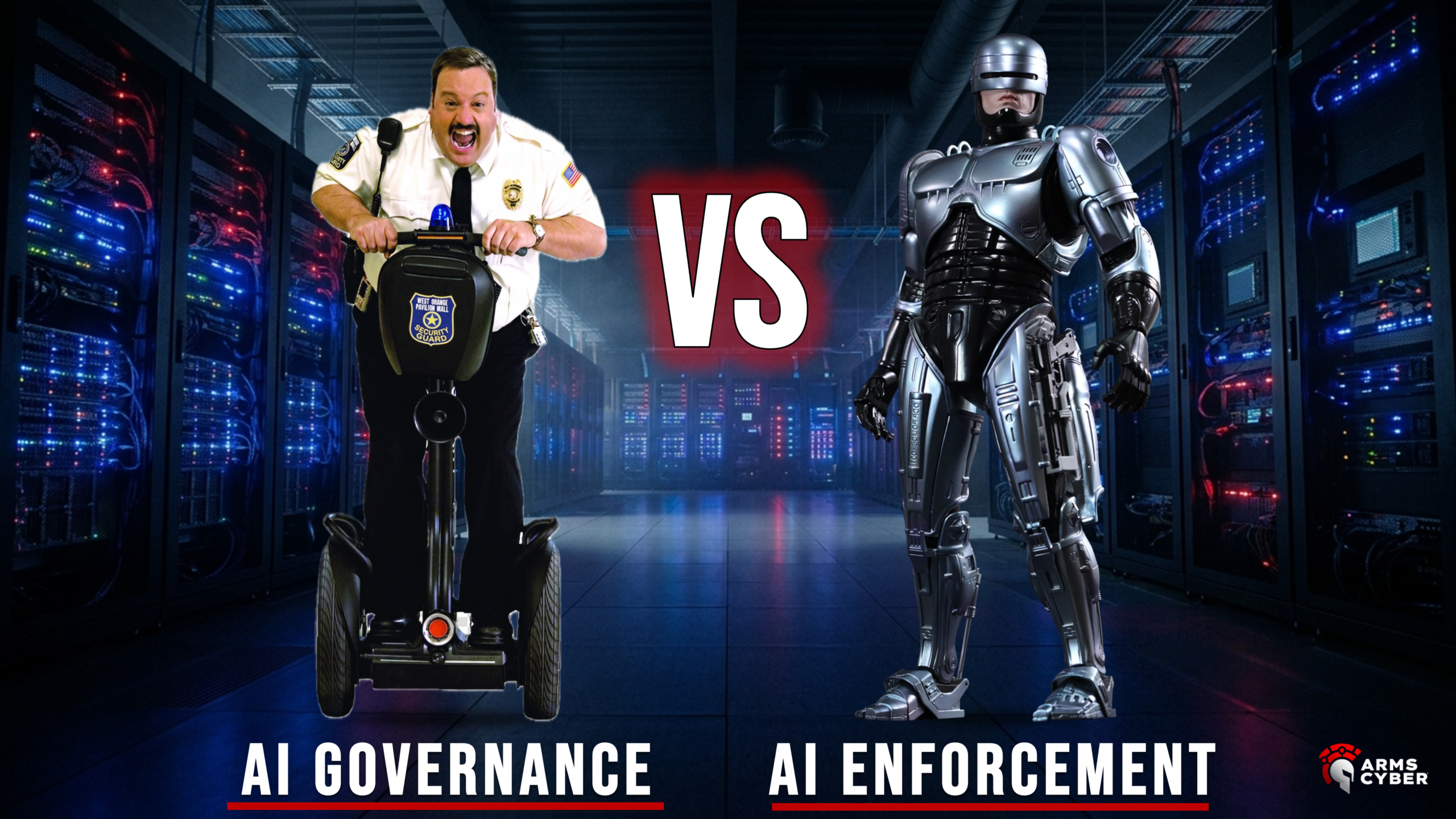
Security has always known the difference between policy and control. Nobody claims they have a firewall just because they have a firewall document. No auditor accepts an access control policy as a substitute for access control. The document says what should happen. The control makes it happen. That distinction holds in every corner of security.
Except one.
Over the last few years, AI has become the domain in which written policy is treated as the operational answer. Acceptable use policies. Approved tools lists. Governance committees and framework adoption. All good work, but all of it just words. It’s worth asking how an industry this disciplined about the difference between policy and control ended up here.
Part of the answer is vocabulary. We’ve been asking “governance” to do two jobs, when it was only built for one.
Governance is the decision. It’s what your organization decided AI should and shouldn’t do: which tools are approved, what data is off limits, where the boundaries sit. Governance is essential. It’s also inert.
Enforcement is the control. It’s what happens on the machine when an AI agent reaches for a customer file at two in the morning and no human is watching. Enforcement doesn’t ask whether the policy was read. It doesn’t care.
Most organizations today have governance and call it both. The gap between those two words is where the exposure lives.
The Governance Stack
Look at what mainstream AI governance actually consists of, and to be clear, this is the responsible version. The organizations doing this are doing it right.
It starts with principles: commitments to transparency, accountability, and human oversight. Beneath those sit the policies: acceptable use, prohibited cases, how AI intersects with IP and confidentiality. Then the operational layer: approved tools lists, vendor review, a cross-functional committee spanning Legal, IT, and Risk. Add a framework to structure the whole effort, an inventory of AI systems, and sign-off workflows that gate deployment until requirements are met.
That’s a lot of legitimate work that solves real problems: ownership, accountability, risk classification, the lifecycle of sanctioned AI. Organizations that have built this stack should be proud of it.
Now notice what every layer has in common. Principles are words. Policies are words. Allowlists, committees, frameworks, inventories: words, meetings, and workflows. The stack governs the process of adopting AI. None of it operates at the place where AI actually runs.
The Audience Problem
The uncomfortable mechanic of any policy is that it only binds an audience that reads it and chooses to comply.
That audience is smaller than we assume. It doesn’t include the employee who never made it to page six. It doesn’t include the model someone downloaded onto a laptop last quarter that never appeared in any inventory. And it categorically does not include the AI itself. An autonomous agent doesn’t attend annual training. It operates at machine speed, on delegated permissions, and it doesn’t wait for human review or approval. It can’t be deterred by a document. Even pasting the policy into its prompt only upgrades it from a non-reader to an unreliable one. Agents usually follow instructions… but “usually” is not a control.
This isn’t a question of anyone’s intent. Most employees are trying to do the right thing. The point is narrower and harder: the things generating actual risk were never in the audience.
The One Allowlist Nobody Enforces
There’s a detail in the middle of the governance stack that makes the whole pattern visible.
Every other approved-anything list is enforced by technology. Approved applications have application control. Approved devices have MDM. Approved identities have IAM. Approved access has conditional access. A CISO enforces allowlists in four different domains before breakfast, and in every one of them, “approved” is a technical state.
Except the approved AI tools list. The fair pushback is that partial enforcement exists: a web filter can block a chatbot domain, and many organizations do exactly that. But that control lives at the network edge, so it only governs the AI that announces itself by crossing the wire. A local model never does. Neither does an agent operating inside an approved application.
Why the Exception Existed
It’s tempting to read all this as negligence. It isn’t.
The reason AI governance stopped at paper is simple: enforcement at the layer where AI executes wasn’t possible. Once installed, a local model or on-device agent can run without ever touching the network, which leaves perimeter tools nothing to inspect. On the endpoint, the closest thing to a control was blocking known executables, which works against software you can name and does nothing about AI operating inside applications you already approved. Nothing could see AI activity as AI activity, much less apply policy to it. The stack was built for a different problem in a different era. When enforcement is off the table, a well-written policy genuinely is the best available option. So that’s what the industry built, and built well.
Habits form around constraints. Standards form around habits. After a while, nobody remembers the constraint, and the exception starts to look like the rule. Perfectly reasonable, right up until the constraint disappears.
The Constraint Just Disappeared
Fortunately, times have changed. AI policy enforcement at the endpoint is now possible.
Real-time visibility into every agent running on an endpoint. Policy applied at the point of execution, to sanctioned and unsanctioned AI alike, whether or not anything ever crosses the network. Not a gate the AI passes through once at deployment, but a control that operates while the AI operates. The capability exists. The category is young, but it’s real.
That changes the meaning of everything above it. When enforcement was impossible, governance on paper was a constraint. Now it’s a choice. Organizations should at minimum know they’re making one.
The Before Times
Every security control we now consider table stakes was once a memo. Access control was a memo before it was IAM. Data handling was a memo before it was DLP. In each case the industry wrote down its intentions, waited for enforcement to become possible, and then moved. Within a few years, nobody could remember doing it any other way.
AI governance is at that exact moment. Ten years from now, “we had a written AI policy and hoped everyone followed it” will sound like keeping the company’s money safe by asking employees nicely not to spend it. Nobody will believe we ran it that way. We’ll barely believe it ourselves.
The policy was never the problem. It was always meant to be the beginning. Now it can be.
Bob Kruse is the Chief Executive Officer at Arms Cyber, where he leads the company’s mission to make ransomware and AI-driven attacks irrelevant. Arms Cyber’s patented Stealth Posture Management platform protects organizations across Windows, Linux, and macOS by making critical data invisible and resilient to attackers and ungoverned AI alike.
In November 2025, Anthropic published something that should have gotten more attention than it did. The report documented...

For most of the last decade, the security industry treated backups as the final word in ransomware defense. The logic was...
New stealth-driven capabilities purpose-built for Veeam environments to shield backup data, services, and execution paths...

On June 9, 2026, Anthropic released Claude Fable 5, the first publicly available model in its Mythos class and, by the company’s...
To connect now, contact: [email protected].