


For most of the last decade, the security industry treated backups as the final word in ransomware defense. The logic was clean and reassuring: if attackers encrypt your systems, you wipe the affected machines, pull the latest clean copy from your backup repository, and resume operations. Pay nothing. Lose little. Move on.
That logic no longer holds.
Modern ransomware operators have studied this playbook far more carefully than most defenders have updated it. They know that a healthy backup environment is the single biggest obstacle between them and a payout, which is precisely why backups are now one of the first targets in a coordinated attack, not the last line of defense against one. By the time encryption is visible, the recovery infrastructure is often already compromised, the snapshots already deleted, the replication already disabled, and the credentials needed to rebuild already in the attacker’s hands.
The uncomfortable truth is that recovery and resilience are not the same thing. Recovery assumes you still have something clean to recover from. Resilience assumes the attacker will try to take that option away, and ensures your operations survive anyway.
The Evolution of Ransomware
Ransomware in 2026 looks nothing like the smash-and-grab encryption events of the late 2010s. The modern ransomware ecosystem operates with the structure, specialization, and patience of a mid-sized software company. Initial access brokers sell footholds. Affiliates lease tooling under ransomware-as-a-service agreements. Negotiators handle the extortion phase. Developers iterate on payloads in response to defender behavior.
The technical sophistication has evolved in lockstep. A modern ransomware campaign is not a single event but a multi-stage operation that typically includes:
- Backup destruction: Snapshots, replicas, and archive volumes are deleted, corrupted, or encrypted before the primary attack begins.
- Data exfiltration: Sensitive data is staged and stolen well before encryption, enabling double or triple extortion regardless of whether the victim can restore.
- Credential theft: Identity platforms, password vaults, and privileged accounts are harvested to enable lateral movement and persistence.
- Hypervisor targeting: Virtualization layers are compromised directly, allowing attackers to encrypt or destroy dozens of virtual machines in a single action.
- Delayed detonation: Payloads sit dormant for days or weeks, contaminating backup chains and ensuring that restored data will simply reintroduce the infection.
- Multi-stage persistence: Multiple footholds are established across the environment so that incident response and eviction become significantly harder.
The objective is no longer temporary disruption. The objective is to systematically remove an organization’s ability to recover, and therefore its ability to refuse payment.
A Modern Ransomware Timeline
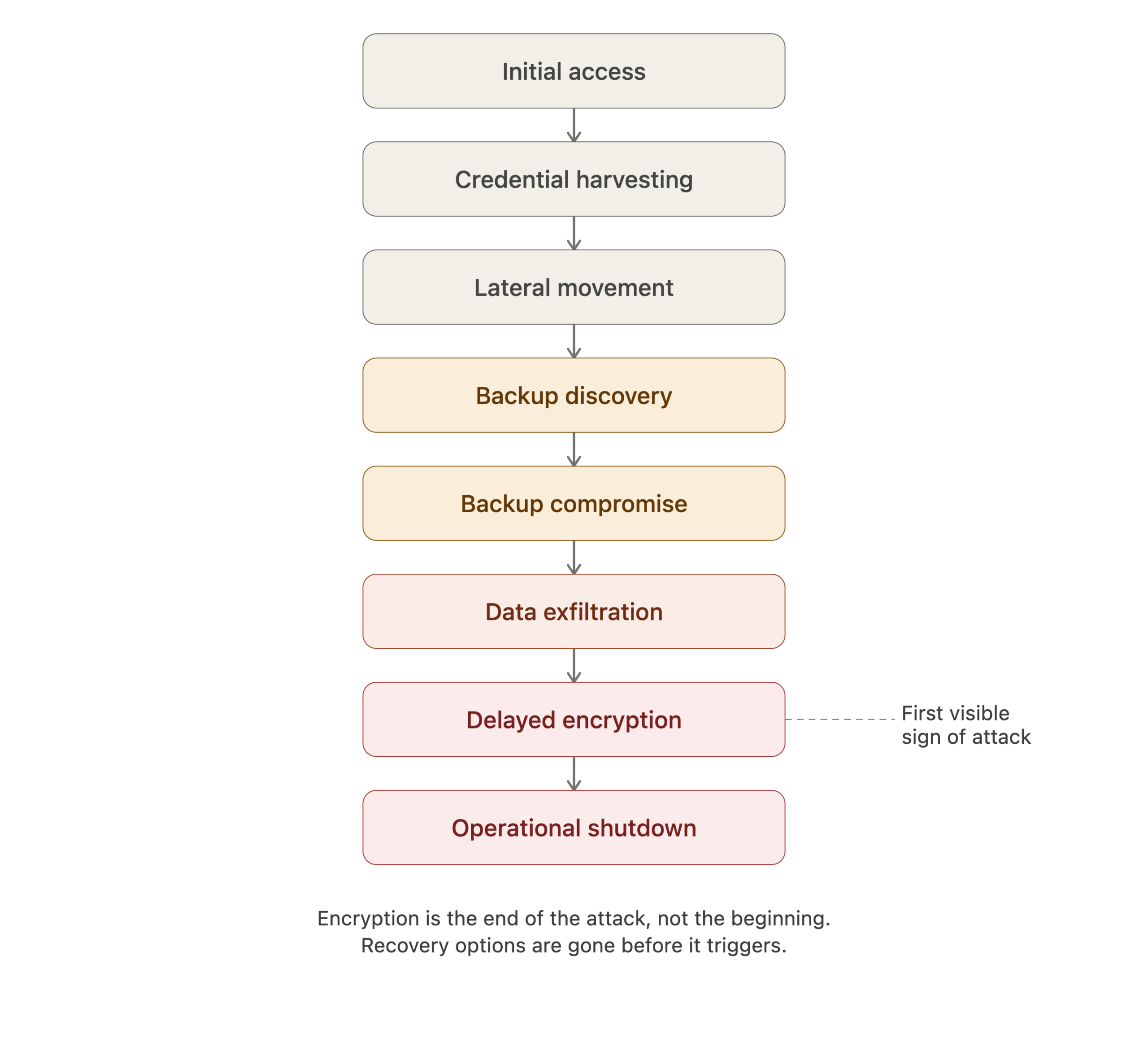
Notice where encryption sits on that timeline. It is not the beginning of the attack. It is the visible end of one. By the time files start changing extensions, the attacker has already spent days or weeks inside the environment, methodically dismantling the recovery options the defender was counting on.
Why Backups Are Being Targeted
Attackers target backups because attackers understand economics. A victim with intact, clean, isolated backups has leverage. A victim without them has none. Every modern playbook now begins with the assumption that backups must be neutralized before encryption is triggered, because the moment backups are gone, the negotiation is effectively over.
In active campaigns, ransomware operators routinely:
- Delete snapshots: Both on-host and on storage arrays, often using legitimate administrative tools to avoid detection.
- Disable replication: Interrupting the flow of data to secondary sites and breaking offsite copies.
- Encrypt repositories: Turning backup servers themselves into encrypted hostages alongside production systems.
- Compromise disaster recovery systems: Pivoting into DR environments to ensure failover is no longer a viable option.
- Corrupt backup chains: Selectively damaging older restore points so that even successful restores reintroduce the malware.
Backup vendors have responded with immutability features, air-gapping, and integrity verification. These are valuable. But they do not change the fundamental problem: recovery is a process that begins after the attack has succeeded. It is, by definition, reactive. And reactive defenses against machine-speed, well-funded, professionally operated adversaries leave too much margin for failure.
Recovery Is Not the Same as Resilience
This is the distinction that defines modern cybersecurity strategy, and it deserves to be stated plainly.
Recovery restores systems after compromise. It accepts that an attack succeeded, accepts the downtime, accepts the data loss between the last clean backup and the moment of encryption, and works backward to a known good state.
Resilience preserves operational integrity during attack conditions. It assumes attackers will get in. It assumes they will try to destroy recovery options. And it ensures that the things that matter most, the data, the operations, the ability to keep serving customers, remain intact and accessible regardless of what the attacker attempts.
Traditional Recovery vs. Data Resilience
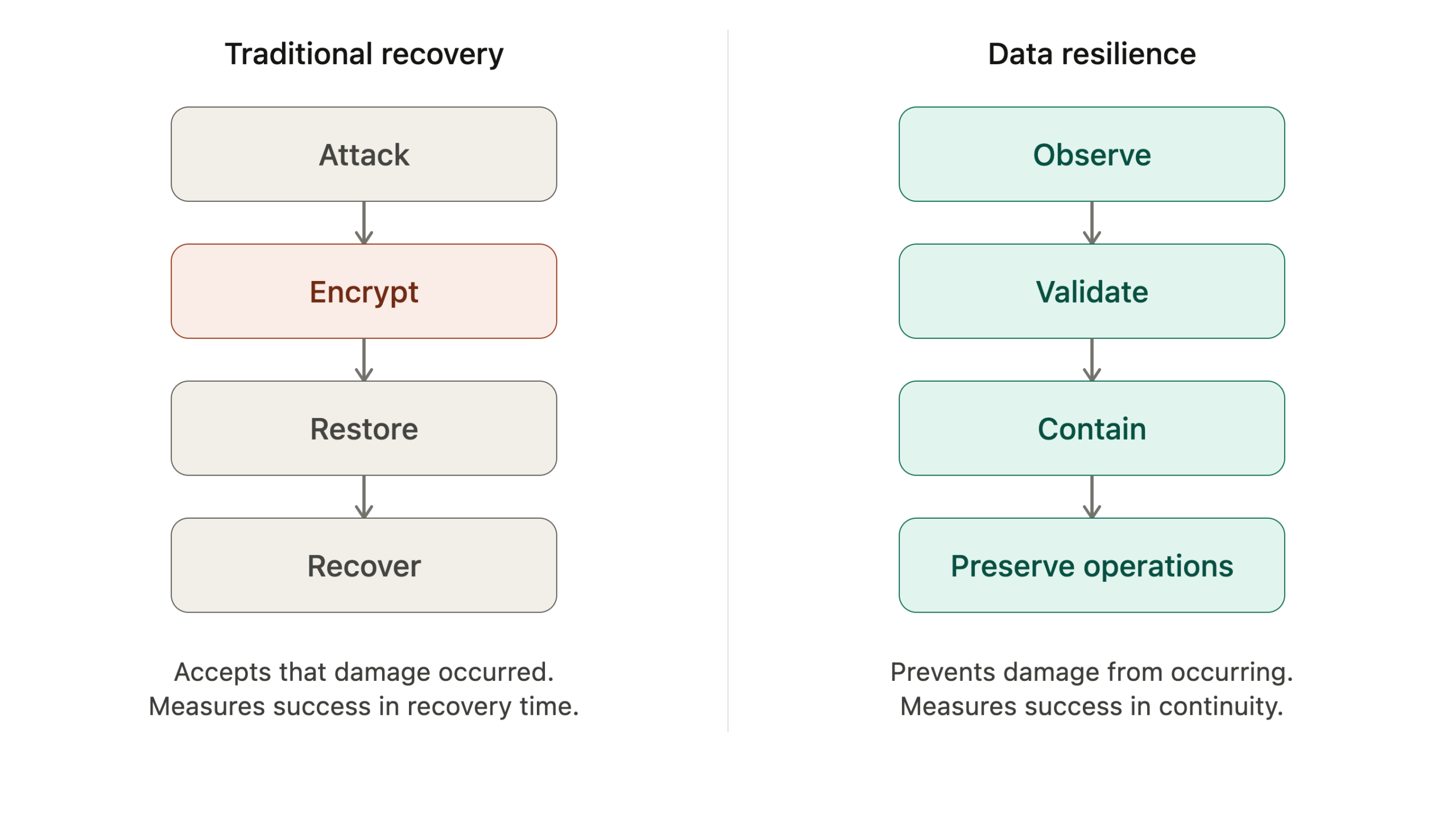
The traditional model is a sequence of losses followed by partial restoration. The resilience model is a continuous loop of protection that never lets the loss happen in the first place. One measures success in hours of downtime and percentage of data recovered. The other measures success in whether the business ever stopped running.
Why Machine-Driven Resilience Matters
There is a timing problem at the heart of modern incident response that no amount of human staffing can solve. A ransomware payload can identify, enumerate, and begin encrypting tens of thousands of files in seconds. A SOC analyst, however skilled, cannot triage an alert, validate the threat, escalate to incident response, and execute containment in that same window. The mismatch is not a question of effort or expertise. It is a question of physics.
This is why modern resilience requires:
- Real-time behavioral analysis: Continuously evaluating what processes are doing, not just what they are.
- Runtime enforcement: Intervening at the moment of execution, before damage propagates.
- Autonomous containment: Taking action without waiting for human approval, while still preserving forensic visibility.
- Continuous integrity validation: Verifying that protected data and systems remain uncompromised at every moment, not just at backup intervals.
Machine-speed attacks require machine-speed defense. Anything slower is not resilience. It is documentation of a loss.
The Arms Cyber Perspective
Arms Cyber was built around a different starting assumption than most of the security industry. Rather than asking how to detect attacks faster or recover from them more cleanly, the platform asks a more fundamental question: what if attackers could not find the data they came to encrypt or steal in the first place?
This is the foundation of the Conceal, Adapt, and Restore strategy that runs through everything Arms Cyber does.
- Conceal. Critical files and directories are hidden from attackers using AI-powered stealth directories. Even when ransomware or AI-crafted malware successfully executes on an endpoint, it cannot locate the assets it was designed to encrypt or exfiltrate. Data that cannot be found cannot be held hostage.
- Adapt. Stealth decoys lure attackers into false engagements, exposing their behavior with high fidelity before any real data is touched. AI-enhanced encryption detection monitors file entropy continuously, so that the first sign of malicious activity triggers containment on the real files, minimizing what attackers can actually reach.
- Restore. Stealth backups store file versions in concealed enclaves that attackers cannot locate or corrupt. When an attack is detected, recovery happens in minutes with data integrity intact, eliminating the downtime and uncertainty of traditional restoration processes.
The New Resilience Architecture
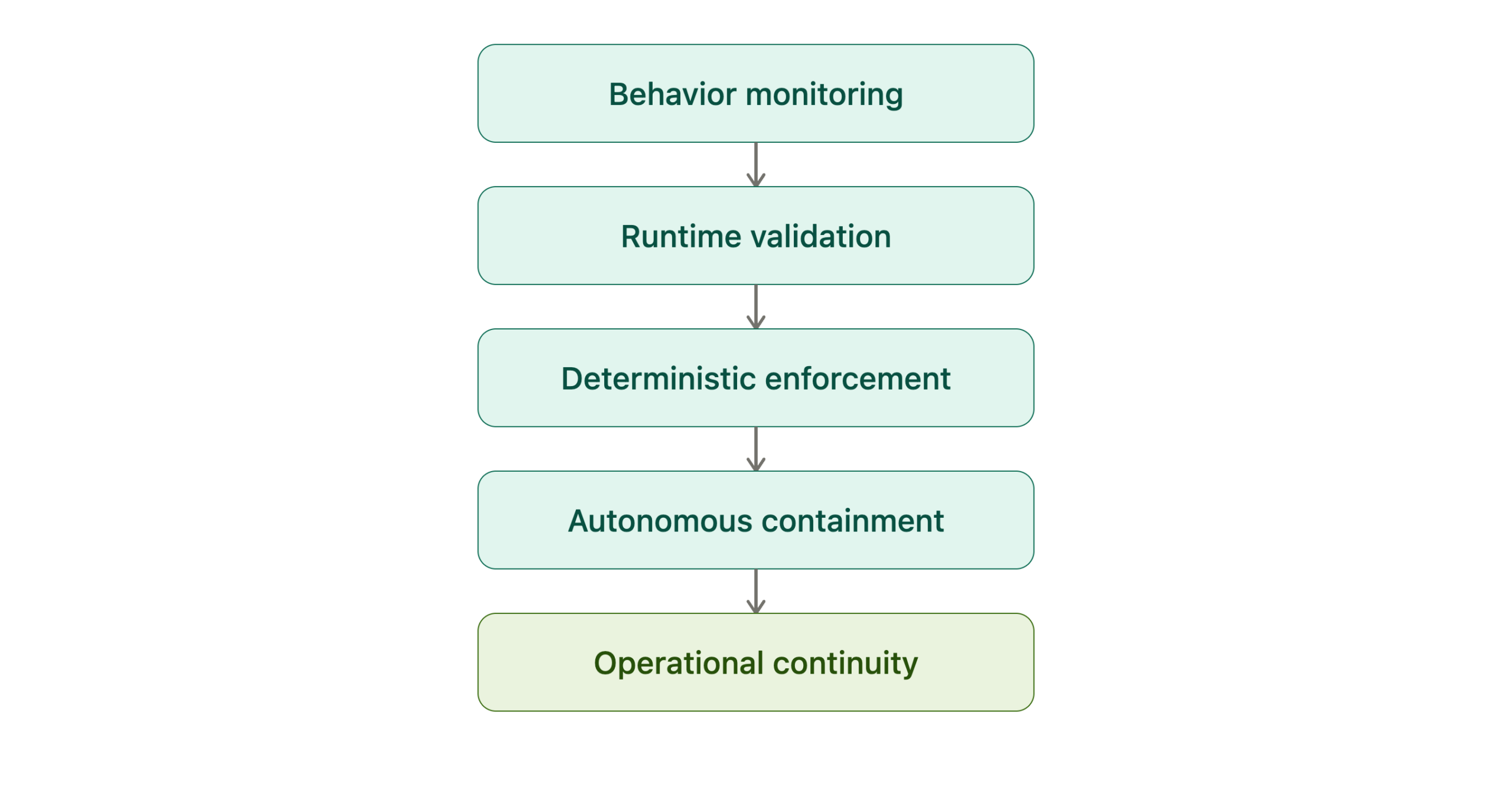
The platform is designed as a stealth-driven overlay that runs alongside existing EDR and XDR investments, CrowdStrike, Microsoft Defender, SentinelOne, and others, rather than competing with them. Deployment requires no reboots and no operational downtime, and the platform works in fully offline and air-gapped environments where many modern security tools simply cannot operate. The result is preemptive ransomware mitigation that preserves operations before encryption ever succeeds.
Conclusion
Backups remain important. Nothing in the modern threat landscape changes the basic principle that organizations should maintain clean, tested, recoverable copies of their critical data. But the era when backups alone constituted a ransomware strategy is over.
Attackers now target the recovery process itself. They study backup architectures, harvest the credentials needed to dismantle them, and ensure that by the time encryption begins, restoration is no longer a real option. Defending against this requires more than better backups. It requires a fundamentally different model, one where critical data is invisible to attackers from the start, where threats are contained at runtime rather than analyzed after the fact, and where operations continue uninterrupted even while an attack is underway.
That is the difference between recovery and true resilience. And in the threat landscape of 2026, it is the difference between an incident and a catastrophe.
Jason T. Williams is the Senior Director of Global Solutions Architecture at Arms Cyber. Our patented Stealth Posture Management platform protects organizations across Windows, Linux, and MacOS by making critical data invisible and resilient to attackers.
New stealth-driven capabilities purpose-built for Veeam environments to shield backup data, services, and execution paths...
On June 9, 2026, Anthropic released Claude Fable 5, the first publicly available model in its Mythos class and, by the company’s...

There’s an arms race happening at the endpoint. EDR products represent a genuine leap forward in enterprise security:...
The same stealth-driven agent that makes ransomware and other attacks irrelevant now closes the visibility gap left by DLP,...

To connect now, contact: [email protected].