



A behavioral baseline is not a product you buy. It is a commitment you make – to understand what your environment actually does, so you can immediately recognize and stop what it should never do.
What Is a Behavioral Baseline: Normal Is the New Signature
In the old world, security meant knowing what bad looked like. In the new world, security means knowing what good looks like – with enough precision that anything outside that envelope triggers immediate action, regardless of whether the threat has ever been seen before.
A behavioral baseline is a mathematical model of what a specific process, user, or system normally does. It is built from observed runtime data – not threat intelligence feeds. It captures the typical number of file operations per minute, which API calls a process makes, which network endpoints it reaches, what its memory usage pattern looks like, and how it relates to other processes in the chain.
Once established, this baseline becomes the enforcement boundary. Deviation from it triggers action. This is a fundamentally different security posture. Instead of asking whether a threat is known, the system asks whether the behavior is authorized. The answer is always computable. The response is always immediate.


The Five Baseline Layers: What You Must Profile to Build a Complete Perimeter
A behavioral perimeter is only as strong as its most incomplete layer. Organizations that profile file system activity but ignore memory allocation, or that monitor network connections but ignore process lineage, create gaps that sophisticated attackers will find. A complete behavioral baseline requires five distinct observation layers working in concert.
- Process Behavioral Profile – Every process on every endpoint is observed over time to establish its normal API call patterns, system call frequency, child process relationships, and execution context. Legitimate software behaves consistently. Malware – even novel malware – almost always deviates from the established profile of the process it hijacks or impersonates.
- Encryption Velocity Baseline – File modification rates are profiled per process, per hour, and per file type. A backup process modifying ten thousand files per hour is normal. A Word document process doing the same thing at 2:47 a.m. is not. Velocity thresholds are set automatically from observed baseline data – no manual configuration required.
- Memory Execution Integrity – Fileless attacks never touch disk – they inject malicious code directly into legitimate process memory. Baseline profiling of memory allocation patterns, executable regions, and anomalous code injection sequences catches these attacks where signatures are structurally blind. This is the layer that stops PowerShell injection, process hollowing, and reflective DLL loading.
- Network Communication Baseline – Every process that makes outbound connections has a normal profile – which domains it connects to, which ports it uses, the typical volume of data transferred, and the timing of connections. Ransomware command-and-control communication, data exfiltration before encryption, and lateral movement across the network all produce network behavior that deviates measurably from the established baseline.
- User and Entity Behavior Analytics – Human users are profiled just like processes. Login times, access patterns, data volumes moved, applications used, and geographic locations all contribute to a behavioral model. Compromised credentials produce measurably abnormal user behavior even when the credentials themselves are valid – this layer catches the insider threat and the credential theft that signatures miss entirely.
Building the Baseline: How Behavioral Profiling Works in Practice
The process of building a behavioral baseline is not instantaneous – it requires an observation period during which the system learns what normal looks like without enforcing anything. Most organizations achieve reliable baselines within 72 hours of observation. The quality of the baseline determines the precision of enforcement: a richer observation period produces fewer false positives and faster detection of genuine threats.
The observation period is not dead time. Organizations that instrument the observation phase correctly emerge with a richer understanding of their own environment than they had before – including undocumented processes, legacy software running unexpectedly, and misconfigured services that were always there but never visible.

Deviation Detection: How the System Recognizes an Attack in Progress
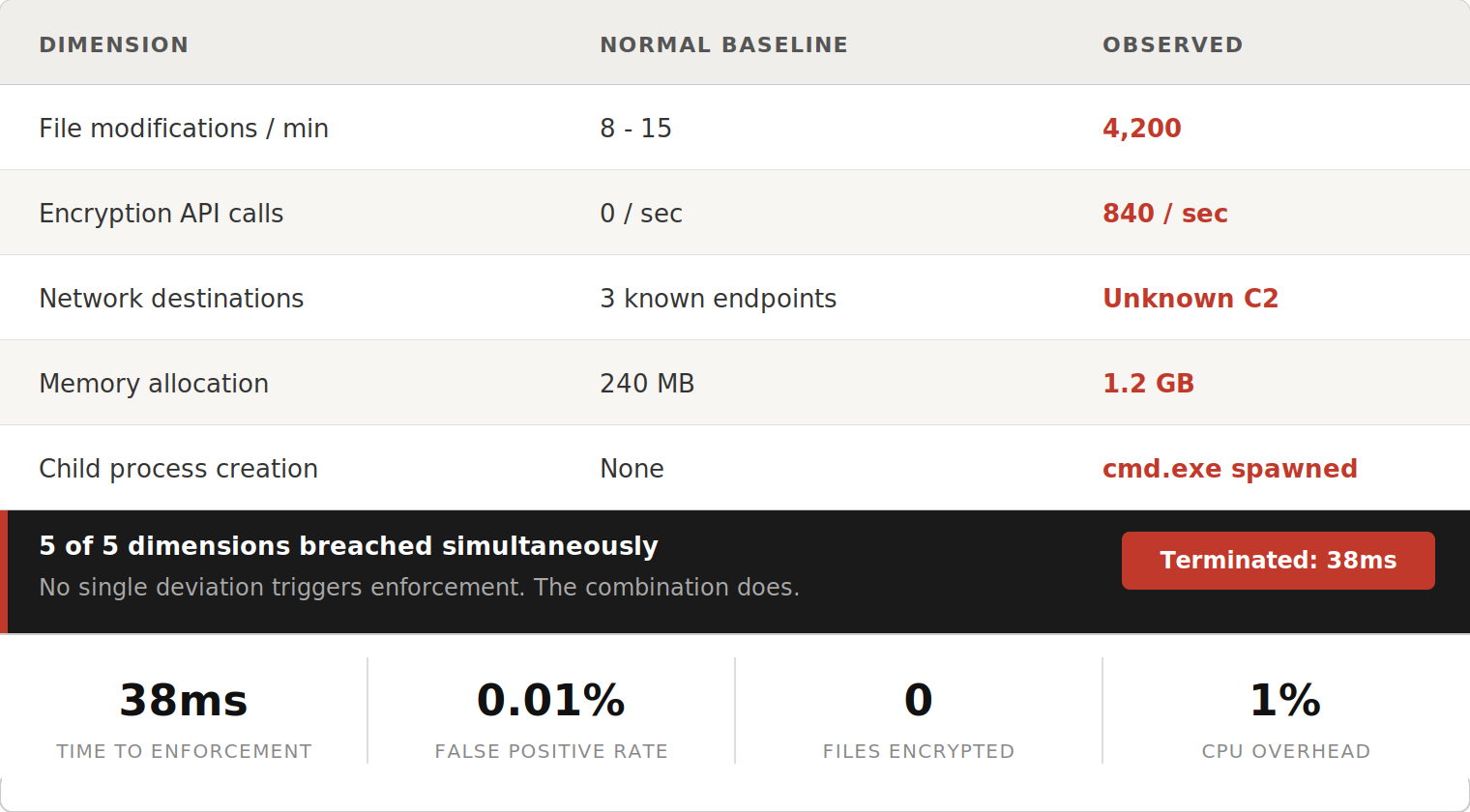
Once the baseline is established, the enforcement engine watches every process in real time against its behavioral model. Deviations are scored across multiple dimensions simultaneously. A single small deviation in one dimension may be acceptable – a combination of deviations across multiple dimensions simultaneously is almost always an attack.
Common Objections: The Four Questions Every Skeptic Asks – Answered
Behavioral baselines are not new in concept – they have been discussed in security research for decades. What is new is the computational power to implement them at enterprise scale without performance impact. Still, resistance is common.
- Our environment is too dynamic. Baselines will never be stable.
Modern baseline engines handle dynamic environments natively. Baselines update continuously, not statically. Deployment events are tagged and excluded during update windows. Ephemeral workloads inherit parent process baselines. The model learns – it is not a one-time snapshot. - False positives will overwhelm our operations team.
Behavioral enforcement replaces alerts with automated action. Enforcement does not generate alerts – it terminates processes. Analysts review blocked actions, not triage queues. Multi-dimensional scoring eliminates single-signal false positives. Production data shows false positive rates under 0.01%. - Our legacy systems cannot be profiled.
Every process has behavior. Legacy systems are often the most stable and easiest to baseline because their behavior changes least frequently. The observation period typically produces cleaner profiles for legacy systems than for modern dynamic workloads. - We cannot afford the performance overhead.
Modern behavioral enforcement adds less than 1% CPU overhead per endpoint. The observation and enforcement engines are designed to run continuously in production without impacting workload performance.
What Behavioral Baselines Mean for Your Role

How to Build Your Behavioral Perimeter in 90 Days
Behavioral baseline deployment does not require a rip-and-replace of existing security infrastructure. It layers on top of what you have. The key discipline is restraint during the observation phase: the temptation to enforce early produces false positives that damage analyst confidence and business trust.
The single most common mistake in baseline deployment is rushing to enforcement mode before the model has matured. Organizations that enforce at Day 14 instead of Day 60 typically generate 40 times more false positives – damaging the credibility of the system before it has a chance to prove its value.

- Instrument (Day 0 to 14) – Deploy sensors across all endpoints in passive observation mode. No enforcement. No alerts. Map coverage and identify any gaps in sensor deployment.
- Observe (Day 14 to 30) – Collect baseline data across all five layers: process behavior, encryption velocity, memory execution, network communications, and user activity. Let the model build without interference.
- Profile and Tune (Day 30 to 60) – Review the statistical models the system has built. Identify legitimate exceptions – scheduled tasks, backup processes, known administrative activity. Tune thresholds to eliminate noise before enforcement begins.
- Validate and Enforce (Day 60 to 90) – Begin live enforcement in a staged rollout. Start with non-production systems, then critical infrastructure, then full coverage. Review blocked actions daily for the first two weeks.
How Do You Know When the Baseline Is Working?
The three metrics every security leader should track once behavioral enforcement is live:
- Blocked events per day: confirms the system is active and catching deviations
- False positive rate: confirms the model is mature and accurate (target under 0.01%)
- Mean time to enforcement: confirms deviations are acted on in milliseconds, not minutes
A mature behavioral enforcement deployment blocks 95% of ransomware-class attacks before a single file is encrypted.
Conclusion: The Perimeter Is No Longer a Place. It Is a Behavior.
The network perimeter was dissolved by cloud. The device perimeter was dissolved by remote work. The identity perimeter is being dissolved by AI-powered credential attacks. What remains – the only defensible boundary in a world where every perimeter has been eroded – is the behavioral boundary of legitimate operations.
Know what normal looks like. Enforce the boundary of normal relentlessly. Everything else is negotiable.
The question is not whether your environment will be targeted. It will be. The question is whether your defense can recognize and stop an attack that has never been seen before, in less time than it takes to encrypt a single file. Behavioral baselines are the only architecture that makes that possible.
Jason T. Williams is the Senior Director of Global Solutions Architecture at Arms Cyber. Our patented Stealth Posture Management platform protects organizations across Windows, Linux, and MacOS by making critical data invisible and resilient to attackers.
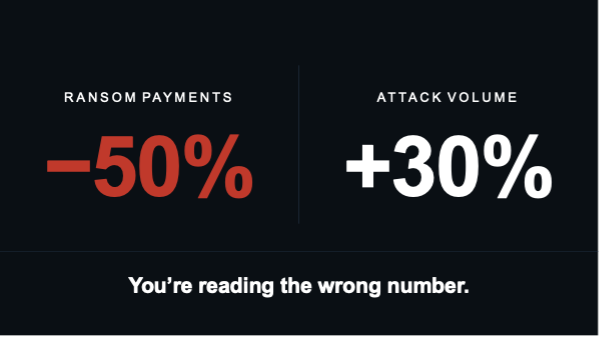
If you only followed the payment data, you might conclude that the ransomware problem is getting better. Average ransom payments...

In 1989, ransomware arrived by floppy disk. The ransom demand was $189. Today, the average payment exceeds $800,000, attack...

If you’ve spent any time talking to CISOs in the last two years, you’ve heard some version of the same frustration:...

The cybersecurity industry has spent the past 2 weeks in a state of controlled hysteria. Anthropic released Claude Mythos...

To connect now, contact: [email protected].