


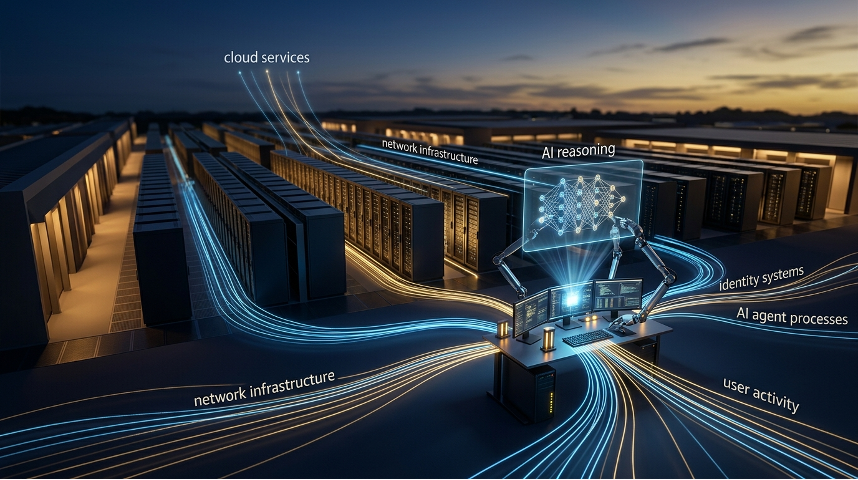
The cybersecurity industry is in the middle of a transformation that will be as consequential as the shift from signature-based detection to behavioral analytics a decade ago. AI reasoning systems, autonomous agents that can triage alerts, investigate incidents, correlate signals across telemetry sources, and orchestrate response actions — are moving from experimental copilots to operational infrastructure. Gartner predicts that 40% of enterprise applications will embed AI agents by the end of 2026 [1]. Fortinet, Palo Alto Networks, CrowdStrike, Microsoft, and Google have all launched or expanded agentic AI capabilities within their security platforms in the past six months [2][3][4]. The autonomous SOC, where AI handles the majority of triage, investigation, and initial response while human analysts focus on strategic decisions, is no longer a vision statement. It’s a product roadmap with delivery dates.
We believe this transformation is real, it’s accelerating, and it will fundamentally reshape how organizations defend themselves. We also believe the industry is at risk of building this revolution on an incomplete foundation — one that can think but can’t act, that can reason but can’t reach, that can identify threats with extraordinary precision but can’t do anything about them at the point where threats actually execute.
That foundation is the endpoint. And this post is about why every AI-driven security innovation, from autonomous investigation to agentic response to AI governance enforcement, ultimately depends on what the endpoint sensor can see, what it can report, and what it can do.
The Reasoning Revolution and its Dependency
The AI reasoning systems being built for security operations are genuinely impressive. Prophet Security’s AI investigation engine queries six different data sources, works through multiple analytical hypotheses, generates dozens of investigative questions, executes hundreds of queries, and delivers a complete investigation with full transparency into every step [5]. D3 Security’s Morpheus AI reasons through investigations dynamically, analyzing email headers, checking sender reputation, inspecting attachments, correlating with endpoint telemetry, tracing lateral movement, all adapting to the evidence discovered rather than following pre-built decision trees [6]. CrowdStrike’s Charlotte AI provides cross-domain investigation across endpoint, identity, and cloud data with what analysts describe as exceptional telemetry quality [4].
These systems represent a genuine capability shift. They don’t just score alerts and hand them off. They autonomously investigate, correlating findings across multiple telemetry sources and delivering conclusions that previously required experienced L2 or L3 analysts spending significant time. In a world where the average mid-market enterprise SOC processes over 4,000 alerts per day [7], where 53% of all alerts are false positives [6], where 40% of alerts are never investigated at all [6], and where 61% of security teams report ignoring alerts that later proved critical [6], autonomous investigation isn’t a luxury. It’s a mathematical necessity.
But here’s what every CISO needs to understand about these reasoning systems: they are only as good as the telemetry they consume. An AI investigation engine that can reason brilliantly about endpoint behavior is useless if the endpoint sensor doesn’t collect the right telemetry. An autonomous SOC that can correlate signals across the full security stack is blind to any domain where telemetry is missing, incomplete, or degraded. A reasoning system that can identify a compromised AI agent executing unauthorized commands can’t do anything about it if the endpoint sensor has no ability to intervene in agent execution.
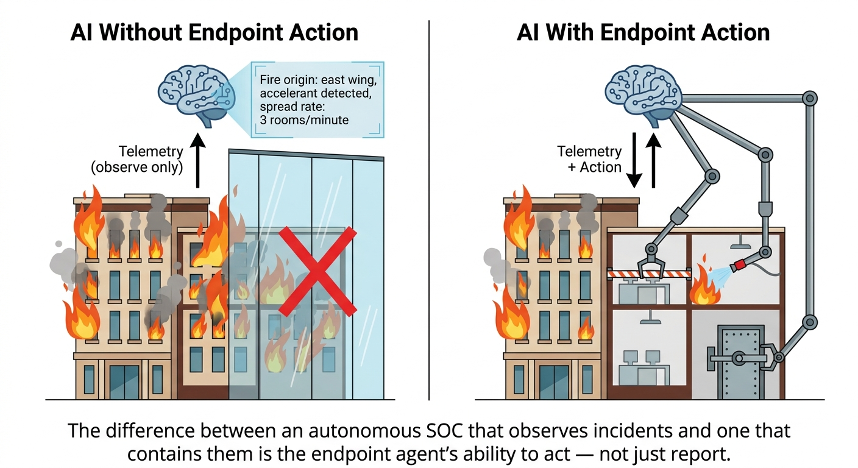
The analogy we keep coming back to is watching a house fire through a window. You can see the flames. You can analyze the fire’s progression. You can predict which rooms will burn next. You can even identify the ignition source with remarkable accuracy. But if you can’t open the door, you can’t put it out. You’re an observer, not a responder. The best analytical capability in the world is worthless without the ability to take action at the point where the threat executes.
And the point where threats execute, where ransomware encrypts files, where AI agents run shell commands, where credentials get harvested, where data gets exfiltrated, where MCP tools get poisoned, where memory gets corrupted, is the endpoint.
The Three Pillars: Telemetry, Action, Governance
We see the endpoint sensor’s role in the AI-driven security future as resting on three pillars, each essential, each dependent on the others.
Pillar 1: Telemetry – The Raw Material of AI Reasoning
Every AI security system starts with data. The reasoning is only as good as the observations it reasons about. And the highest-fidelity, most operationally relevant security telemetry originates at the endpoint.
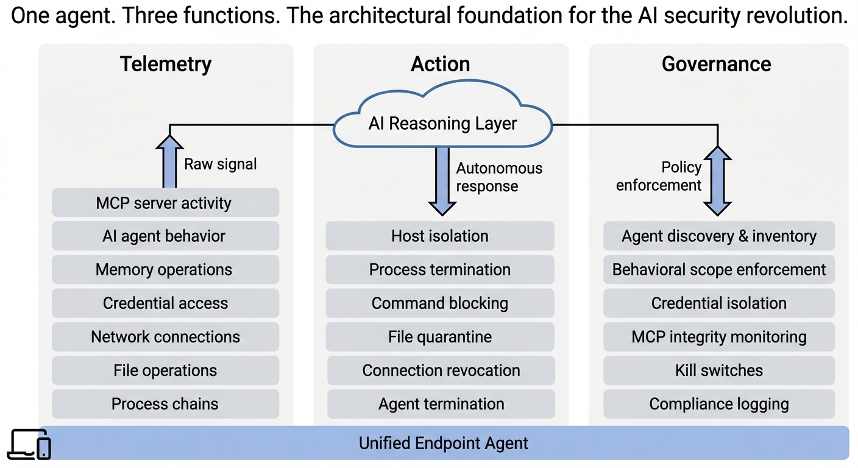
The endpoint sees what no other source can. It sees process creation chains, which parent process launched which child process, with what arguments, under what user context. It sees file system operations, which files were read, written, modified, deleted, and by which process. It sees network connections, which processes established which connections to which destinations, including connections that never cross a network monitoring point because they’re internal to the host. It sees credential access, which processes touched which credential stores, which tokens were requested, which authentication events occurred. It sees memory operations — which processes allocated memory, loaded libraries, or modified running code.
This is the telemetry that makes AI reasoning about security threats possible. When Prophet Security’s investigation engine queries CrowdStrike to check endpoint telemetry for a suspicious source IP [5], it’s accessing exactly this data. When D3 Security’s Morpheus AI correlates a phishing alert with endpoint telemetry to identify payload execution and trace lateral movement [6], it’s consuming process, file, and network data that only the endpoint sensorcollects. When any AI reasoning system attempts to answer the fundamental question – “is this activity malicious?” – the endpoint telemetry is typically the decisive evidence.
The quality of that telemetry matters enormously. CrowdStrike’s Charlotte AI is described by analysts as benefiting from “exceptional telemetry quality” because the Falcon EDR agent provides clean, high-fidelity signal with fewer false positives [4]. That quality isn’t a coincidence. It’s the result of years of engineering the endpoint sensor to collect the right data at the right granularity with the right context. The AI reasoning layer amplifies whatever the telemetry layer provides. High-fidelity telemetry produces high-confidence conclusions. Incomplete or degraded telemetry produces uncertain conclusions that analysts must manually verify, defeating the purpose of autonomous investigation.
For CISOs evaluating AI-driven security platforms, the telemetry question should be the first question: what does the endpoint sensor collect, at what granularity, with what context, and how reliably? The sophistication of the AI reasoning layer is secondary to the quality of the data it reasons about. You cannot reason your way to a correct conclusion from incomplete evidence.
Pillar 2: Action – The Difference Between Observation and Defense
This is where the industry’s current trajectory has a critical gap. The AI reasoning revolution is producing systems that can identify threats with remarkable speed and accuracy. But identification without action is surveillance, not security.
When an AI investigation engine determines that a compromised credential is being used for cloud reconnaissance, the value of that determination depends entirely on what happens next. If the system can autonomously revoke the credential, isolate the affected endpoint, and trigger a broader audit, as happened in the Prophet Security case study [5], the incident is contained. If the system can only generate an alert that enters the analyst queue alongside 4,000 other daily alerts, the determination has value but dramatically less operational impact.
The action capability that matters most lives at the endpoint. Isolating a compromised host from the network is an endpoint action. Killing a malicious process is an endpoint action. Blocking a shell command that an AI agent is about to execute is an endpoint action. Quarantining a file before it can be exfiltrated is an endpoint action. Revoking an MCP connection that’s been compromised is an endpoint action. Halting an AI agent that’s been hijacked through tool poisoning is an endpoint action.
Without these action capabilities at the endpoint, the most sophisticated AI reasoning system in the world is watching the fire through the window. It knows the house is burning. It knows exactly how the fire started. It can predict with high confidence which room will catch fire next. And it can do nothing except alert a human who may or may not respond in time.
The autonomous SOC vision, where AI handles detection, investigation, and initial response at machine speed, is architecturally dependent on the endpoint sensor’s ability to execute response actions. Triage without response is just faster alerting. Investigation without containment is just better documentation. The AI revolution in security operations only delivers its full value when the reasoning layer can reach through the endpoint sensort to take action at the point of execution.
For CISOs, this means the endpoint sensor’s action capabilities are not a checkbox on a feature comparison, they’re the architectural prerequisite for every autonomous security capability on the roadmap. An endpoint sensor that collects telemetry but can’t isolate hosts, kill processes, block commands, or enforce policy constraints is providing half the foundation the AI revolution requires.
Pillar 3: Governance Enforcement – Prosecuting Policy at the Point of Execution
The third pillar extends beyond traditional security operations into the AI governance domain that has emerged as one of the most urgent challenges of 2026.
As we’ve documented throughout this blog series, the enterprise AI landscape is experiencing explosive, largely ungoverned growth. Only 14.4% of organizations have full security approval for their AI agent deployments [8]. On average, only 47% of an organization’s AI agents are actively monitored [8]. Eighty-eight percent of organizations reported confirmed or suspected AI agent security incidents [8]. Non-human identities outnumber humans by 25x to 100x or more, with 97% having excessive privileges [9]. MCP connections are deployed by developers and data scientists without security team visibility. AI-generated code ships to production with 10x the vulnerability rate of human-written code [10].
The governance gap, the distance between the AI systems organizations are deploying and the controls governing those systems, is widening, not closing. And the only place where AI governance policy can be enforced at runtime is the endpoint.
Consider what governance enforcement actually requires. Discovering which AI agents, MCP servers, and agentic processes are running in the environment, that’s an endpoint inventory operation. Monitoring whether an AI agent is operating within its authorized scope, that requires endpoint behavioral observation. Blocking an agent from accessing resources outside its declared purpose, that requires endpoint-level policy enforcement. Detecting modifications to MCP tool descriptions that might indicate poisoning, that requires endpoint-level file integrity monitoring. Enforcing credential isolation so that AI agents operate with scoped, short-lived tokens instead of inherited user credentials, that requires endpoint-level credential governance. Implementing kill switches that can halt AI agent execution in real time when anomalous behavior is detected, that requires endpoint-level process control.
Every one of these governance capabilities depends on the endpoint sensor. An AI gateway that monitors prompts and responses addresses part of the governance picture. A supply chain scanner that vets MCP servers before deployment addresses another part. But the runtime enforcement, the ability to intervene in what an AI agent actually does on the system where it’s executing, can only happen at the endpoint.
The EU AI Act, which became enforceable for high-risk systems in August 2026, requires continuous monitoring, automatic logging, human oversight capability, and demonstrable cybersecurity resilience [11]. These aren’t requirements for the model layer or the API layer. They’re requirements for the execution layer, the endpoint where AI systems run, make decisions, and take actions. Compliance without endpoint enforcement is documentation without teeth.
For CISOs navigating both the security operations transformation and the AI governance challenge simultaneously, the endpoint sensor is the convergence point. The same agent that provides telemetry for AI-driven threat investigation also provides telemetry for AI governance monitoring. The same agent that executes response actions for autonomous incident containment also enforces governance policy for AI agent behavior. The same agent that isolates a compromised host also halts a hijacked AI agent. Building these as separate capabilities on separate agents creates the fragmentation and visibility gaps that sophisticated adversaries exploit. Building them as integrated capabilities on a unified endpoint sensor creates the architectural foundation that both the AI security revolution and the AI governance imperative require.
Why the Endpoint and Not Some Other Layer?
There’s an implicit question in this argument that deserves a direct answer: why the endpoint? Why not the network, the cloud control plane, the identity layer, or the AI gateway?
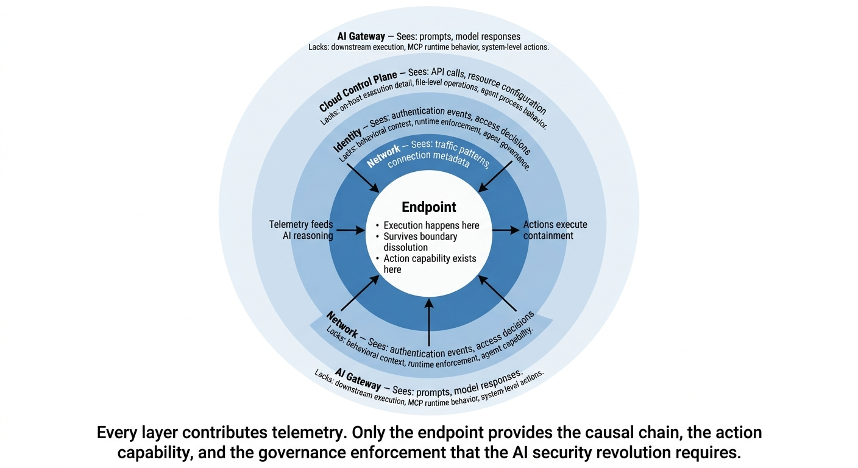
Each of those layers provides valuable telemetry and enforcement capability for specific domains. Network monitoring sees traffic patterns. Cloud control planes see API calls and resource configurations. Identity layers see authentication events. AI gateways see prompts and responses. None of them is dispensable.
But the endpoint is unique in three ways that make it the irreducible foundation.
The endpoint is where execution happens. When a threat transitions from reconnaissance to action, when ransomware encrypts a file, when an agent executes a shell command, when a credential is harvested, when data leaves a system, that transition happens at the operating system level on an endpoint. Network monitoring sees the connection. The endpoint sees the process that made the connection, the file it accessed, the credential it used, the command it executed, and the context in which all of that occurred. The endpoint provides the causal chain, not just the observable symptom.
The endpoint is the only layer that survives the dissolution of other boundaries. Network perimeters dissolved with cloud adoption. Identity boundaries blur with non-human identities and delegated agent credentials. AI gateway boundaries miss the execution that happens downstream of the model interaction. The endpoint persists as the execution substrate regardless of how the architecture above it evolves. An AI agent running on an endpoint interacts with the operating system whether it was invoked through an MCP connection, a direct API call, a multi-agent delegation chain, or a user’s natural language prompt. The endpoint sees all of it.
The endpoint is where action capability exists. You can observe threats from many layers. You can only intervene in most threats from the endpoint. Process isolation, file quarantine, network disconnection, credential revocation, agent termination. These are endpoint operations. An AI reasoning system that identifies a threat and needs to contain it must ultimately reach the endpoint to execute that containment. The endpoint sensor is the last mile of autonomous response.
This doesn’t diminish the value of other telemetry sources. The best AI reasoning systems correlate across all available sources, endpoint, network, identity, cloud, email, to build complete investigation narratives. But the endpoint telemetry is the backbone, the action capability is the enforcement mechanism, and the governance function is the policy layer. Without the endpoint, the other sources provide context without consequence.
What This Means for the CISO’s Architecture Decisions
If the argument is correct, that endpoint access is the foundation of the AI cybersecurity revolution, then several architectural decisions follow directly.
The endpoint is your most strategic security investment. Not the SIEM. Not the AI copilot. Not the cloud security posture management tool. Those are all important, but they all depend on what the endpoint sensor provides them. The quality, breadth, and depth of endpoint telemetry determines the ceiling of what every AI-driven capability above it can achieve. An AI reasoning system built on limited endpoint telemetry will produce limited conclusions. An autonomous response system without endpoint action capability will produce alerts without containment. Invest in the endpoint sensor first. Everything else scales from there.
Unify security and AI governance on the same endpoint sensor. The convergence we’ve described, where threat detection telemetry and AI governance telemetry come from the same sensor, where incident response actions and governance enforcement actions use the same mechanism, isn’t just efficient. It’s architecturally necessary. Separate agents for separate functions create separate visibility domains, separate enforcement gaps, and separate points of failure. The AI agents you’re trying to govern run on the same endpoints where you’re trying to detect threats. One agent, one telemetry stream, one enforcement layer.
Evaluate AI security vendors on their endpoint foundation. When vendors present AI reasoning capabilities, autonomous investigation features, or agentic response workflows, the first question isn’t about the sophistication of the AI. It’s about the telemetry the AI consumes and the actions it can take. CrowdStrike’s Charlotte AI is effective in part because Falcon’s endpoint sensor provides exceptional telemetry quality [4]. The AI amplifies the endpoint data. Without that data, there’s nothing to amplify. Ask every vendor: what does your endpoint sensor collect? What actions can it take? What governance policies can it enforce? If the answers are thin, the AI capabilities built on top will be thin too.
Prepare your endpoint architecture for autonomous operations. The autonomous SOC is coming. AI systems will increasingly execute response actions at machine speed without waiting for human approval. That means the endpoint sensor must be architecturally prepared for autonomous action: the guardrails must be in place, the policy enforcement must be reliable, and the action capabilities must be tested under adversarial pressure. Our purple teaming framework is designed to validate exactly this, that the endpoint governance layer functions correctly when an AI system decides to act. Organizations that haven’t tested their endpoint sensor’s behavior under autonomous conditions are not ready for the autonomous SOC, regardless of how sophisticated their AI reasoning layer is.
Don’t let telemetry fragmentation become your architectural ceiling. The average enterprise runs 28 security tools [6], each with its own telemetry format, its own dashboard, and its own query language. AI reasoning systems can correlate across multiple sources, but fragmentation introduces latency, context loss, and gaps. The organizations best positioned for the AI-driven future are the ones building toward unified telemetry architectures, ideally with the endpoint as the high-fidelity backbone and other sources providing supplementary context. Open standards like OCSF help, but the architectural direction is clear: unified data is the prerequisite for autonomous operations [7][4].
The Revolution has a Dependency
We’re optimistic about where the industry is headed. The AI reasoning systems being built for security operations are genuinely transformative. The move from human-speed investigation to machine-speed investigation, from static playbooks to dynamic reasoning, from alert-driven response to autonomous containment will fundamentally improve the security posture of every organization that adopts them. Gartner’s prediction that by 2030, preemptive cybersecurity solutions will account for 50% of security spending [12] reflects the magnitude of the transformation underway.
But every element of that transformation has a dependency: the endpoint. The reasoning systems need endpoint telemetry to reason about. The autonomous response systems need endpoint action capability to respond with. The governance frameworks need endpoint enforcement to govern through. The AI security revolution is being built, and it’s being built well. The question is whether the foundation it’s built on, the endpoint sensor’s ability to see, to act, and to enforce, is strong enough to support what’s coming.
The organizations that invest in endpoint capability now, not just as a detection tool, but as the unified platform for telemetry, action, and governance, will be the ones that capture the full value of the AI security revolution. The ones that underinvest will find themselves with brilliant AI systems that can identify every threat in real time and contain none of them. They’ll be watching the fire through the window, wondering why the house is still burning.
The AI revolution in cybersecurity is real. The endpoint is where it lives or dies.
Bob Kruse is the Chief Executive Officer and Brad Potteiger is the Chief Technology Officer at Arms Cyber, where they lead the development of next-generation preemptive security & anti-ransomware technology. Arms Cyber’s patented Stealth Posture Management platform protects organizations across Windows, Linux, and MacOS by making critical data invisible and resilient to attackers.
References
[1] Gartner, “Gartner Identifies the Top Strategic Technology Trends for 2026,” October 2025. https://www.gartner.com/en/newsroom/press-releases/2025-10-20-gartner-identifies-the-top-strategic-technology-trends-for-2026
[2] Fortinet, “Fortinet Advances Its Security Operations Platform with Unified SOC, Agentic AI, and Expanded Endpoint Security,” March 2026. https://www.fortinet.com/corporate/about-us/newsroom/press-releases/2026/fortinet-advances-its-security-operations-platform-with-unified-soc-agentic-ai-and-expanded-endpoint-security
[3] Microsoft Security Blog, “Secure Agentic AI End-to-End,” March 2026. https://www.microsoft.com/en-us/security/blog/2026/03/20/secure-agentic-ai-end-to-end/
[4] Prophet Security, “Top 5 AI SOC Platforms of 2026,” February 2026. https://www.prophetsecurity.ai/blog/top-5-ai-soc-analyst-platforms
[5] The Hacker News, “AI SOC Investigation Has Moved Beyond Triage: Two Cases That Show Where It Actually Matters,” March 2026.https://thehackernews.com/expert-insights/2026/03/ai-soc-investigation-has-moved-beyond.html
[6] D3 Security, “What Is an Autonomous SOC Platform?” March 2026. https://d3security.com/resources/what-is-an-autonomous-soc-platform/
[7] Help Net Security, “Why SOCs Are Moving Toward Autonomous Security Operations in 2026,” February 2026. https://www.helpnetsecurity.com/2026/02/24/socs-autonomous-security-operations-strategies/
[8] Gravitee, “State of AI Agent Security 2026 Report: When Adoption Outpaces Control,” January 2026. https://www.gravitee.io/blog/state-of-ai-agent-security-2026-report-when-adoption-outpaces-control
[9] CSO Online, “Why Non-Human Identities Are Your Biggest Security Blind Spot in 2026,” February 2026. https://www.csoonline.com/article/4125156/why-non-human-identities-are-your-biggest-security-blind-spot-in-2026.html
[10] Apiiro, “4x Velocity, 10x Vulnerabilities: AI Coding Assistants Are Shipping More Risks,” September 2025. https://apiiro.com/blog/4x-velocity-10x-vulnerabilities-ai-coding-assistants-are-shipping-more-risks/
[11] European Commission, “AI Act — Shaping Europe’s Digital Future.” https://digital-strategy.ec.europa.eu/en/policies/regulatory-framework-ai
[12] Gartner, “Gartner Says That in the Age of GenAI, Preemptive Capabilities, Not Detection and Response, Are the Future of Cybersecurity,” September 2025. https://www.gartner.com/en/newsroom/press-releases/2025-09-18-gartner-says-that-in-the-age-of-genai-preemptive-capabilities-not-detection-and-response-are-the-future-of-cybersecurity
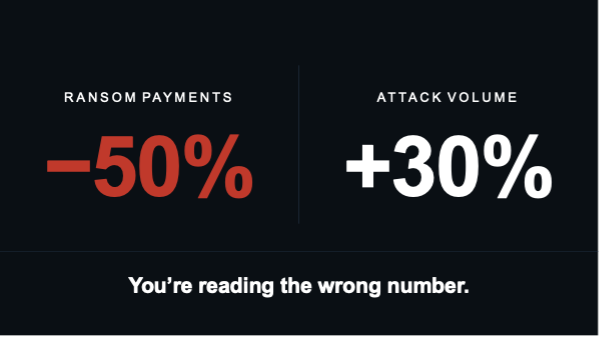
If you only followed the payment data, you might conclude that the ransomware problem is getting better. Average ransom payments...

In 1989, ransomware arrived by floppy disk. The ransom demand was $189. Today, the average payment exceeds $800,000, attack...

If you’ve spent any time talking to CISOs in the last two years, you’ve heard some version of the same frustration:...

The cybersecurity industry has spent the past 2 weeks in a state of controlled hysteria. Anthropic released Claude Mythos...
To connect now, contact: [email protected].