


The data tells a clear story: 76% of global organizations now admit they cannot match the speed and sophistication of AI-powered attacks. Ransomware dwell times have been cut nearly in half. Polymorphic malware that rewrites itself in real time accounts for the majority of detected threats. We are witnessing the emergence of fully autonomous attack pipelines that require no human operator at all.
We are no longer in an era where the attacker has a slight edge; we are in an era where the adversary operates at machine speed while most defenders remain constrained by human-speed processes. Something has to fundamentally change.
The AI Threat Inflection Point
For years, the cybersecurity industry discussed AI-powered attacks as a future concern. That future has arrived. In 2025, 87% of organizations experienced AI-enabled cyberattacks, deepfake incidents surged over 2,000% compared to 2022, and AI-driven credential theft rose 160% in a single year. Ransomware groups are leveraging generative AI to craft more convincing phishing lures, automate vulnerability scanning, and deploy negotiation bots that accelerate payment cycles.
A recent Malwarebytes report confirmed what many of us in the field have been anticipating: 2025 delivered the first confirmed cases of AI-orchestrated attacks. Looking ahead, 2026 is expected to bring fully autonomous ransomware pipelines, where small crews can simultaneously target dozens of organizations at scale.
The asymmetry is staggering. An attacker can spin up an AI agent and execute an entire kill chain, from reconnaissance to lateral movement to encryption, in a fraction of the time it takes a SOC analyst to triage a single alert. The median ransomware dwell time has dropped from nine days to five, and that number is still falling. When 57% of SOC analysts report that traditional threat intelligence is insufficient against AI-accelerated attacks, we aren’t looking at a tooling gap. We are looking at an architectural failure.
Why Detection and Response Has Hit Its Ceiling
To be clear: detection and response remain essential. EDR, XDR, and SIEM tools have transformed security operations over the past decade and remain vital layers of the stack. However, the core assumption of this model, that we can identify a threat fast enough to intervene before damage occurs, is breaking down.
Modern ransomware does not provide a comfortable window for investigation. Attackers using AI-enhanced obfuscation, “living-off-the-land” techniques, and fileless execution methods are slipping past behavioral analytics. The tools built to find needles in haystacks are facing adversaries who can change the shape of the needle in real time. Meanwhile, the haystacks are growing exponentially: Gartner projects over one million documented CVEs by 2030, a 300% increase from today.
The result? Organizations deploying AI-powered defenses still experienced breaches in nearly a third of cases last year. Those relying on legacy security tools incurred 42% higher costs per incident. The detection-and-respond model is not struggling because the tools are insufficient; it is failing because it was designed for a world where attackers moved at human speed. We need a paradigm that doesn’t just react faster, but one that makes the reaction unnecessary.
Enter the Autonomous Cyber Immune System
Over the past several years, we have worked with research partners on a concept that captures the necessary future of cybersecurity: the Autonomous Cyber Immune System (ACIS). This framework resonates because it articulates the architectural shift that forward-thinking practitioners have championed for years.
The concept draws inspiration from biology. A biological immune system doesn’t wait for a conscious appointment; it operates continuously, identifying foreign threats, adapting to novel pathogens, and neutralizing them before they cause systemic damage. It operates autonomously at the speed of biology.
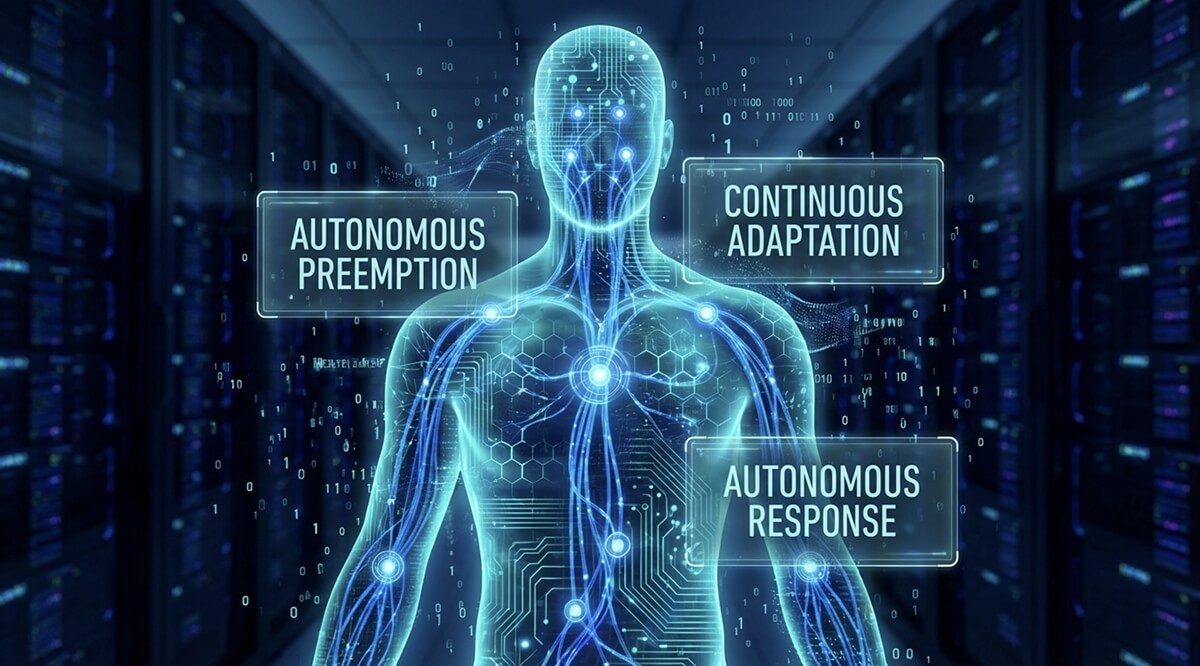
ACIS envisions a digital parallel: intelligent, decentralized, adaptive defenses that operate at machine speed to preempt, contain, and neutralize threats before they achieve their objectives. As traditional reactive measures become obsolete against an expanding global attack surface, ACIS introduces three transformative pillars: autonomous preemption, continuous adaptation, and autonomous response.
Autonomous Preemption: Shifting the Battlefield
Preemption is the most critical shift. Instead of waiting for an attacker to move, preemptive security changes the environment so the attacker’s playbook no longer functions.
Consider ransomware: whether it is Qilin, Akira, or a new RaaS variant, the operational logic is consistent. Gain access, discover data, and encrypt it. Preemptive defense disrupts this logic at the root. Technologies like automated moving target defense (AMTD), obfuscation, and advanced deception ensure the attacker has nothing to find and nothing to leverage. By diverting adversaries to deceptive data, defenders can analyze movements while the attack itself fails. The battlefield shifts before the first shot is fired.
This is the direction Gartner is pointing to when they predict that preemptive solutions will account for 50% of IT security spending by 2030, up from less than 5% today. This is a complete restructuring of how organizations invest in defense.
Continuous Adaptation: Evolving Faster Than the Threat
A static defense, no matter how clever, eventually becomes reverse-engineered. This is the lesson of every signature-based tool ever built. Biological immunity succeeds because it is not fixed; it learns and develops new responses to novel threats in real time.
In cybersecurity, continuous adaptation means defenses that are themselves polymorphic, environments that morph dynamically so that no two moments present the same attack surface. It requires leveraging agentic AI and domain-specific models that understand the particular topology of an environment and autonomously adjust defenses to match emerging patterns.
This is critical because the ransomware ecosystem is accelerating; we saw 45 newly observed threat groups in 2025 alone, pushing the total number of active extortion operations to a record 85 distinct actors. In this landscape, adaptation is a survival requirement.
Autonomous Response: Matching Machine Speed
When a threat materializes, response must happen at machine speed. Many organizations are currently hamstrung by alert fatigue and SOC bottlenecks. By the time a critical alert is escalated and acted upon, encryption is often already complete.
Autonomous response closes this gap, isolating compromised endpoints and initiating recovery in seconds to maintain operational continuity. The goal is not to remove humans from the loop, but to ensure time-critical actions happen automatically so human analysts can focus on high-level strategy rather than fire-fighting.
The Ransomware Imperative
Ransomware remains the most financially devastating and operationally disruptive cyber threat facing organizations today. The total cost of an attack—including downtime, recovery, reputational damage, and regulatory consequences—now ranges between $1.8 million and $5 million per incident. Healthcare organizations face average breach costs exceeding $7 million, while manufacturing saw incidents surge 61% in 2025 alone. The ecosystem is only becoming more automated, more fragmented, and more aggressive.
However, ransomware is also the ideal proving ground for the ACIS model. These attacks follow a deterministic logic that can be preempted. The data they target can be concealed and protected. Attack patterns can be detected through deception before any real damage occurs. Furthermore, recovery can be architected in advance so that even a successful breach does not result in a viable extortion event.
Organizations that adopt this model, investing in preemption, adaptation, and autonomous response, will find that ransomware transforms from an existential crisis into a manageable operational risk. For those who remain tethered to reactive models, the costs of maintaining the status quo will only continue to rise.
Brad Potteiger is the Chief Technology Officer at Arms Cyber, where he leads the development of next-generation anti-ransomware technology. Arms Cyber’s patented Stealth Posture Management platform protects organizations across Windows, Linux, and macOS by making critical data invisible to attackers.
Arms Cyber Announces Integration with Veeam to Automate the Isolation of Ransomware-Infected Backups
The technical alliance bridges the gap between active security tooling and data recovery, utilizing the Veeam Incident API...

To connect now, contact: [email protected].